Link to StumbleUpon

Showing posts with label harvest. Show all posts

Sunday, September 18, 2011

Harvesting Pumpkins

Few garden crops represent the joys and colors of autumn more than pumpkins. Their color is synonymous with the season's holidays, changing leaves, and spiced desserts. Easy to grow in most gardens, they're easy to harvest too.

Close to harvest time

I had my first frost this morning and the pumpkins were the first in my vegetable garden to show damage. While my 7,500' garden gets cold temperatures earlier than most, fall's unpredictable weather portends the end for all warm season crops like pumpkins. Whether for nutmeg-spiced pies or sneering Jack-O-Lanterns, pumpkins should be harvested before freezing weather settles in.

You should leave pumpkins on the vine as long as you can. They'll only ripen and change color while still growing. Unlike tomatoes and bananas, pumpkins won't improve after picking.

There are a few ways to determine that pumpkins are ready to harvest. First is the color. If you're growing pumpkins for autumn decorations or Halloween carving, color is probably an important factor. Once the pumpkin on the vine reaches an appropriate color, it can be harvested. The color may deepen if left on the vine, but if you're happy with the hue go ahead and pick it.

The skin of the pumpkin hardens as it matures. Stick your thumbnail into the outer skin of a pumpkin. If the skin is hard and your thumbnail doesn't easily penetrate it, it's ready to cut free. If it feels soft and you leave a deep incision, leave it on the vine a little longer.

The thumbnail test

The stem that attaches a pumpkin to the plant should normally be green and sturdy. As the fruit reaches its natural maturity, the stem will begin to crack. That's a good time to harvest too. The vine will begin to shrivel and the pumpkin may separate itself at this point saving you some effort.

Thumping a finger against a ripe pumpkin should produce a hollow sound. It's hard to describe what a hollow sound is to someone who hasn't heard it. Kind of like a drum but not as loud or vibrant. To me this is the hardest way to determine harvest time.

If a heavy frost or freeze hits, the leaves will be killed, the plant can no longer support the pumpkins, and the vine dies back. Some gardeners wait until this point to harvest. I've discovered small fruit that I didn't know I had after a freeze clears away the big leaves. The pumpkins can handle light frost temperatures but they should be harvested and protected before a hard freeze. Freezing temperatures can damage the flesh.

When harvesting, wear gloves. The vines and stems are prickly. When you've decided that's it time, use shears or a knife to cut through the stem. Particularly for Jack-O-Lanterns leave enough stem to act as a handle for the lid. Three or four inches is enough. If the vine has died back the pumpkin should be easy to separate from it manually, but I usually cut it to leave a clean stem.

Cutting the stem

Don't carry the pumpkin by the stem; use two hands. If you carry a heavy pumpkin by the stem it could separate, breaking the pumpkin when it impacts the ground or at the very least removing the handle of the lid and affecting its aesthetic appeal. Also a lost stem can expose the pumpkin to early rot.

The vines, dead or alive, are ready for the compost pile. They can add a lot of green component while still fresh and are a good balance to dried leaves that usually appear about the same time as harvest.

After cutting the pumpkin from the vine, it should cure for at least 10 days if you plan to store it. Curing further hardens the skin and keeps in moisture so the flesh stays fresh for long periods. If you don't plan to store it, you don't need to go through the curing process and it can be used right away. Properly cured pumpkins can be stored at 50F degrees (10C) for two or three months and even as long as six months in a dark, well-ventilated room.

Curing pumpkins

Expose the pumpkins to the sun to cure. Ideally, high temperatures and high humidity are needed for the best curing (at least 80F degrees and 80% humidity), but the reality is that few gardeners have those conditions at harvest time. I don't even have those conditions during the prime growing season. Place the pumpkins in a sunny, dry area so they won't rot from wet ground contact. As long as the days are sunny and warm the pumpkins will cure. If more than a light frost threatens, cover them at night with straw, plastic or a tarp, or bring them inside.

After curing, or to help facilitate curing, bring the pumpkins indoors. This should definitely be done before freezing temperatures damage them. Don't stack the pumpkins or allow them to touch each other; this can cause soft spots and potential rot. Avoid placing them near apples and other ripe fruit. The ethylene gas they emit can shorten the pumpkin storage  life.

That's all there is to selecting pumpkins for harvest and curing. Collecting the seeds for eating or future planting is always a good idea too. If you have pumpkins in your garden and you haven't harvested, take a close look at them because it may be time.
Few garden crops represent the joys and colors of autumn more than pumpkins. Their color is synonymous with the season's holidays, changing leaves, and spiced desserts. Easy to grow in most gardens, they're easy to harvest too.

Close to harvest time

I had my first frost this morning and the pumpkins were the first in my vegetable garden to show damage. While my 7,500' garden gets cold temperatures earlier than most, fall's unpredictable weather portends the end for all warm season crops like pumpkins. Whether for nutmeg-spiced pies or sneering Jack-O-Lanterns, pumpkins should be harvested before freezing weather settles in.

You should leave pumpkins on the vine as long as you can. They'll only ripen and change color while still growing. Unlike tomatoes and bananas, pumpkins won't improve after picking.

There are a few ways to determine that pumpkins are ready to harvest. First is the color. If you're growing pumpkins for autumn decorations or Halloween carving, color is probably an important factor. Once the pumpkin on the vine reaches an appropriate color, it can be harvested. The color may deepen if left on the vine, but if you're happy with the hue go ahead and pick it.

The skin of the pumpkin hardens as it matures. Stick your thumbnail into the outer skin of a pumpkin. If the skin is hard and your thumbnail doesn't easily penetrate it, it's ready to cut free. If it feels soft and you leave a deep incision, leave it on the vine a little longer.

The thumbnail test

The stem that attaches a pumpkin to the plant should normally be green and sturdy. As the fruit reaches its natural maturity, the stem will begin to crack. That's a good time to harvest too. The vine will begin to shrivel and the pumpkin may separate itself at this point saving you some effort.

Thumping a finger against a ripe pumpkin should produce a hollow sound. It's hard to describe what a hollow sound is to someone who hasn't heard it. Kind of like a drum but not as loud or vibrant. To me this is the hardest way to determine harvest time.

If a heavy frost or freeze hits, the leaves will be killed, the plant can no longer support the pumpkins, and the vine dies back. Some gardeners wait until this point to harvest. I've discovered small fruit that I didn't know I had after a freeze clears away the big leaves. The pumpkins can handle light frost temperatures but they should be harvested and protected before a hard freeze. Freezing temperatures can damage the flesh.

When harvesting, wear gloves. The vines and stems are prickly. When you've decided that's it time, use shears or a knife to cut through the stem. Particularly for Jack-O-Lanterns leave enough stem to act as a handle for the lid. Three or four inches is enough. If the vine has died back the pumpkin should be easy to separate from it manually, but I usually cut it to leave a clean stem.

Cutting the stem

Don't carry the pumpkin by the stem; use two hands. If you carry a heavy pumpkin by the stem it could separate, breaking the pumpkin when it impacts the ground or at the very least removing the handle of the lid and affecting its aesthetic appeal. Also a lost stem can expose the pumpkin to early rot.

The vines, dead or alive, are ready for the compost pile. They can add a lot of green component while still fresh and are a good balance to dried leaves that usually appear about the same time as harvest.

After cutting the pumpkin from the vine, it should cure for at least 10 days if you plan to store it. Curing further hardens the skin and keeps in moisture so the flesh stays fresh for long periods. If you don't plan to store it, you don't need to go through the curing process and it can be used right away. Properly cured pumpkins can be stored at 50F degrees (10C) for two or three months and even as long as six months in a dark, well-ventilated room.

Curing pumpkins

Expose the pumpkins to the sun to cure. Ideally, high temperatures and high humidity are needed for the best curing (at least 80F degrees and 80% humidity), but the reality is that few gardeners have those conditions at harvest time. I don't even have those conditions during the prime growing season. Place the pumpkins in a sunny, dry area so they won't rot from wet ground contact. As long as the days are sunny and warm the pumpkins will cure. If more than a light frost threatens, cover them at night with straw, plastic or a tarp, or bring them inside.

After curing, or to help facilitate curing, bring the pumpkins indoors. This should definitely be done before freezing temperatures damage them. Don't stack the pumpkins or allow them to touch each other; this can cause soft spots and potential rot. Avoid placing them near apples and other ripe fruit. The ethylene gas they emit can shorten the pumpkin storage  life.

That's all there is to selecting pumpkins for harvest and curing. Collecting the seeds for eating or future planting is always a good idea too. If you have pumpkins in your garden and you haven't harvested, take a close look at them because it may be time.

Wednesday, August 31, 2011

Getting Big Pumpkins

Pumpkins grow in many gardens. Harvesting the big, orange globes in autumn and carving them for Halloween is part of Americana. Made into pumpkin pie, they provide a delectable treat. For many of us, we want a lot of pumpkins and we like them big, but as the growing season wanes those desires are at odds with each other. Often, you can have many pumpkins or you can have large pumpkins, but you can't have both.

A pumpkin and pumpkin flower

Pumpkins are basically a squash. Like most squash plants, they will keep producing flowers and small fruit until a freeze hits. A typical pumpkin plant will have only two primary vines, but will have numerous flowers develop along their lengths as they continually creep beyond the confines of their growing space. The flowers are either male or female with just one goal in mind: make baby pumpkins.

Like all other plants, they put a lot of effort into developing the baby pumpkins. To the plant it doesn't matter how big the fruit grows as long as it produces seeds to enable the pumpkin family to continue for future generations. So the plant churns out a lot of flowers and a lot of baby pumpkins. A lot of small, baby pumpkins. Humans, particularly Americans, think bigger is better.

To get big fruit you need to threaten the plant. When the vines have many babies growing along them, they'll send relatively equal amount of nutrients to each so that they can all grow and develop. When some of those offspring suddenly disappear, the plant boosts the energy to the remaining fruit so that they'll grow quickly and overcome whatever catastrophe caused the loss.

You need to be that catastrophe. With just a few weeks before the first frost, time becomes an adversary when it comes to growing big pumpkins. By plucking off flowers and pruning very small fruit, you divert extra energy to the remaining parts of the plant. When only one or two pumpkins remain on the vine, all of the energy from those large, elephant-ear leaves flows to them. The boost is enough to cause a perceptible size increase.

To get big pumpkins, first look at the flowers. After you have the young pumpkins on the vine, remove the flowers that can develop into competition. To make it easy, remove them all. To save effort, look closely at them. Male flowers will be on long, thin stalks. Female flowers will grow on shorter stalks with a very small bulb at their base; that is the baby pumpkin in the making. You really only need to remove the female flowers to prevent additional pumpkins.

Many flowers on a vine with just one small fruit

Don't act too quickly, though. Wait until your chosen fruit is at least the size of a softball. It's not unusual for baby pumpkins to shrivel on the vine. The plant does its own job of selective pruning when a fruit is competing too much with a neighbor or if it isn't ideally located on the vine. You don't want your favorite baby to be one that the plant sacrifices at the same time you're removing all other potential pumpkins.

You can also remove fruit of any size that has already developed in an effort to boost the size of the remaining ones. Use pruning shears or a sharp knife to separate them from the plant. The vines can be prickly so it's a good idea to wear gloves. How many you remove is up to you.

A typical vine will produce up to five pumpkins, potentially more. Competitive pumpkin growers will select the single, fastest-growing pumpkin on a plant and remove all others. That's one way they grow monstrous pumpkins. If you're growing for Halloween carving, you may want to keep one or two of the pumpkins that are perfectly shaped and remove ones that don't match up. If you're going for size, keep the biggest and remove all of the small, developing ones. If you want quantity, be happy with the three or four that are doing best and sacrifice the rest; accept that they all won't reach their full size potential.

My best vine has two pumpkins that are already growing past 10 inches in diameter. They look great and I'm very happy with them. Another on that vine is about eight inches and there's one more about the size of an orange. Though I'd like all four, the smallest just doesn't have enough time to develop in the two or three weeks remaining before our potential first frost. To benefit the other three, it has to go.

My wife planted her own vines in a separate bed a few weeks after I did. The late start is reflected in the size of her pumpkins. They are just now approaching the softball stage. To have any hope of sizable fruit on her plants we have been systematically removing all of the flowers and will soon remove some of the small pumpkins once we determine the best candidates. We may be left with a single pumpkin on each vine to hope for a harvest.

Removing the competition

Pumpkins are up to 90 percent water and pruning the plant will induce stress so be sure to continue watering the vines. You don't want to overdo it with saturated soil, but just because there are fewer pumpkins on the vine it doesn't mean the plant's water needs have decreased. Continue normal irrigation.

You probably aren't growing a champion pumpkin over 1810 pounds (the current record). You just want some that will delight your kids or grandkids, or make a good pie. I don't like to unnecessarily harm or prune any plant, but when it comes to pumpkins, selective pruning will provide the best results. In many respects, for pumpkins size does matter.

Pumpkins grow in many gardens. Harvesting the big, orange globes in autumn and carving them for Halloween is part of Americana. Made into pumpkin pie, they provide a delectable treat. For many of us, we want a lot of pumpkins and we like them big, but as the growing season wanes those desires are at odds with each other. Often, you can have many pumpkins or you can have large pumpkins, but you can't have both.

A pumpkin and pumpkin flower

Pumpkins are basically a squash. Like most squash plants, they will keep producing flowers and small fruit until a freeze hits. A typical pumpkin plant will have only two primary vines, but will have numerous flowers develop along their lengths as they continually creep beyond the confines of their growing space. The flowers are either male or female with just one goal in mind: make baby pumpkins.

Like all other plants, they put a lot of effort into developing the baby pumpkins. To the plant it doesn't matter how big the fruit grows as long as it produces seeds to enable the pumpkin family to continue for future generations. So the plant churns out a lot of flowers and a lot of baby pumpkins. A lot of small, baby pumpkins. Humans, particularly Americans, think bigger is better.

To get big fruit you need to threaten the plant. When the vines have many babies growing along them, they'll send relatively equal amount of nutrients to each so that they can all grow and develop. When some of those offspring suddenly disappear, the plant boosts the energy to the remaining fruit so that they'll grow quickly and overcome whatever catastrophe caused the loss.

You need to be that catastrophe. With just a few weeks before the first frost, time becomes an adversary when it comes to growing big pumpkins. By plucking off flowers and pruning very small fruit, you divert extra energy to the remaining parts of the plant. When only one or two pumpkins remain on the vine, all of the energy from those large, elephant-ear leaves flows to them. The boost is enough to cause a perceptible size increase.

To get big pumpkins, first look at the flowers. After you have the young pumpkins on the vine, remove the flowers that can develop into competition. To make it easy, remove them all. To save effort, look closely at them. Male flowers will be on long, thin stalks. Female flowers will grow on shorter stalks with a very small bulb at their base; that is the baby pumpkin in the making. You really only need to remove the female flowers to prevent additional pumpkins.

Many flowers on a vine with just one small fruit

Don't act too quickly, though. Wait until your chosen fruit is at least the size of a softball. It's not unusual for baby pumpkins to shrivel on the vine. The plant does its own job of selective pruning when a fruit is competing too much with a neighbor or if it isn't ideally located on the vine. You don't want your favorite baby to be one that the plant sacrifices at the same time you're removing all other potential pumpkins.

You can also remove fruit of any size that has already developed in an effort to boost the size of the remaining ones. Use pruning shears or a sharp knife to separate them from the plant. The vines can be prickly so it's a good idea to wear gloves. How many you remove is up to you.

A typical vine will produce up to five pumpkins, potentially more. Competitive pumpkin growers will select the single, fastest-growing pumpkin on a plant and remove all others. That's one way they grow monstrous pumpkins. If you're growing for Halloween carving, you may want to keep one or two of the pumpkins that are perfectly shaped and remove ones that don't match up. If you're going for size, keep the biggest and remove all of the small, developing ones. If you want quantity, be happy with the three or four that are doing best and sacrifice the rest; accept that they all won't reach their full size potential.

My best vine has two pumpkins that are already growing past 10 inches in diameter. They look great and I'm very happy with them. Another on that vine is about eight inches and there's one more about the size of an orange. Though I'd like all four, the smallest just doesn't have enough time to develop in the two or three weeks remaining before our potential first frost. To benefit the other three, it has to go.

My wife planted her own vines in a separate bed a few weeks after I did. The late start is reflected in the size of her pumpkins. They are just now approaching the softball stage. To have any hope of sizable fruit on her plants we have been systematically removing all of the flowers and will soon remove some of the small pumpkins once we determine the best candidates. We may be left with a single pumpkin on each vine to hope for a harvest.

Removing the competition

Pumpkins are up to 90 percent water and pruning the plant will induce stress so be sure to continue watering the vines. You don't want to overdo it with saturated soil, but just because there are fewer pumpkins on the vine it doesn't mean the plant's water needs have decreased. Continue normal irrigation.

You probably aren't growing a champion pumpkin over 1810 pounds (the current record). You just want some that will delight your kids or grandkids, or make a good pie. I don't like to unnecessarily harm or prune any plant, but when it comes to pumpkins, selective pruning will provide the best results. In many respects, for pumpkins size does matter.

Thursday, October 21, 2010

I Say Potato, You Say Potato

Any harvest is a good harvest and yesterday provided a great harvest. This year was the first time I grew potatoes and I was rewarded with an abundance of the fleshy tubers. Potatoes are one of those mystery plants; you never really know how it's doing until you dig it up. The product you're hoping for develops underground, out of sight, so it's very rewarding to wait for months and finally see the results.

My Yukon Gold potatoes

I planted three different kinds and had the best results with "Yukon Gold"; the "Red Norland" faded early and didn't produce very much; the "Goldrush Russet" had the strongest plants but produced small tubers.

You should harvest the potatoes after the top plants die off. The autumn frost creates this normal cycle. Leaving the potatoes in the ground for a few weeks after the dieback is no problem as long as you harvest before heavy rains come. This time in the ground allows the skins to thicken which increases the time they can later be stored. Potatoes in saturated soil can quickly rot.

Digging them up is the hardest part of the harvest. You can't pull the plant out with potatoes attached; the stem and leaves tear off leaving the tubers in the ground. The objective is to turn over the soil and pick up the intact crop. You can carefully use a shovel, but you run the risk of slicing through some of the potatoes. Or you can use a garden fork as I did and skewer more of them than you'd prefer. Either way you'll probably lose some of the big ones.

There are methods of growing potatoes other than in soil. Gardeners around the world have had success by growing them in straw. You plant the "seed potato" (not really a seed, but a piece of a potato with an eye) shallowly in the soil and as it grows you cover it with straw. You keep the straw moist and add more through the season as the plants grows. It's important that the tubers stay protected from the sun. When it comes time to harvest, you just pull back the straw and easily claim your reward.

After the potatoes are harvested they need to cure for one to two weeks. If you bruised or cut some of them as I did, temperatures around 70 degrees during this period will aid in healing the wounds. If you live in an area with good weather after the harvest you can leave the potatoes in little piles on the ground and let the air circulate around them. Cover the piles with a cloth or burlap to protect them from the sun and bring them in or put them under a sturdier cover if rains come. We have both rain and freezing weather in the forecast so I put my harvest in paper bags in the pantry. In a few weeks I'll begin using them and handing out sample bags to friends and family.

As you know from the bags of potatoes you buy in the market, they store well for a long time. The key is to keep them in a cool, dark place. They also prefer a humid environment during storage. If you store them too long they may shrivel and begin to sprout from the eyes. You can still eat them, but the texture may change. It's best to eat them before they reach that point.

Potatoes can be quite susceptible to disease and pests, particularly the Colorado potato beetle. They can defoliate plants quite quickly. Some potato varieties offer some resistance to pests and disease. Many pesticides are available, but potatoes are among the easier plants to grow organically. If you see the pests you can pluck them off. Rotating your crops and growing your potatoes in a different plot each year will help reduce disease problems.

The success with potatoes means that I'll grow them again. They were surprisingly easy. Once planted they only required regular watering. Next year I just may experiment with the straw method. I grew the three varieties I did because they were packaged together in an inexpensive box at a local garden center. Over the winter I'll do a little more research and try to select the best varieties for my area. I'll let you know what I find out.
Any harvest is a good harvest and yesterday provided a great harvest. This year was the first time I grew potatoes and I was rewarded with an abundance of the fleshy tubers. Potatoes are one of those mystery plants; you never really know how it's doing until you dig it up. The product you're hoping for develops underground, out of sight, so it's very rewarding to wait for months and finally see the results.

My Yukon Gold potatoes

I planted three different kinds and had the best results with "Yukon Gold"; the "Red Norland" faded early and didn't produce very much; the "Goldrush Russet" had the strongest plants but produced small tubers.

You should harvest the potatoes after the top plants die off. The autumn frost creates this normal cycle. Leaving the potatoes in the ground for a few weeks after the dieback is no problem as long as you harvest before heavy rains come. This time in the ground allows the skins to thicken which increases the time they can later be stored. Potatoes in saturated soil can quickly rot.

Digging them up is the hardest part of the harvest. You can't pull the plant out with potatoes attached; the stem and leaves tear off leaving the tubers in the ground. The objective is to turn over the soil and pick up the intact crop. You can carefully use a shovel, but you run the risk of slicing through some of the potatoes. Or you can use a garden fork as I did and skewer more of them than you'd prefer. Either way you'll probably lose some of the big ones.

There are methods of growing potatoes other than in soil. Gardeners around the world have had success by growing them in straw. You plant the "seed potato" (not really a seed, but a piece of a potato with an eye) shallowly in the soil and as it grows you cover it with straw. You keep the straw moist and add more through the season as the plants grows. It's important that the tubers stay protected from the sun. When it comes time to harvest, you just pull back the straw and easily claim your reward.

After the potatoes are harvested they need to cure for one to two weeks. If you bruised or cut some of them as I did, temperatures around 70 degrees during this period will aid in healing the wounds. If you live in an area with good weather after the harvest you can leave the potatoes in little piles on the ground and let the air circulate around them. Cover the piles with a cloth or burlap to protect them from the sun and bring them in or put them under a sturdier cover if rains come. We have both rain and freezing weather in the forecast so I put my harvest in paper bags in the pantry. In a few weeks I'll begin using them and handing out sample bags to friends and family.

As you know from the bags of potatoes you buy in the market, they store well for a long time. The key is to keep them in a cool, dark place. They also prefer a humid environment during storage. If you store them too long they may shrivel and begin to sprout from the eyes. You can still eat them, but the texture may change. It's best to eat them before they reach that point.

Potatoes can be quite susceptible to disease and pests, particularly the Colorado potato beetle. They can defoliate plants quite quickly. Some potato varieties offer some resistance to pests and disease. Many pesticides are available, but potatoes are among the easier plants to grow organically. If you see the pests you can pluck them off. Rotating your crops and growing your potatoes in a different plot each year will help reduce disease problems.

The success with potatoes means that I'll grow them again. They were surprisingly easy. Once planted they only required regular watering. Next year I just may experiment with the straw method. I grew the three varieties I did because they were packaged together in an inexpensive box at a local garden center. Over the winter I'll do a little more research and try to select the best varieties for my area. I'll let you know what I find out.

Tuesday, October 19, 2010

Tea in the Garden II

Herbs are a great addition to any garden. They're easy to grow in a small plot or pot, add fragrance and texture to the landscape, and offer you a ticket to many culinary adventures. For me, few things are as enjoyable as a walk to my herb garden to snip off a little fresh parsley, sage, rosemary, and thyme, and toss it all into a pot of simmering tomatoes. Who knew that Simon and Garfunkel were singing about a recipe for spaghetti sauce.

In the next few days I'll harvest my sage, rosemary, and thyme, along with oregano and tarragon. After they're finished drying, I'll crumble them and fill the little glass bottles that already have printed labels on them. Those are the bottles of mass-produced herbs that I bought at the grocery store years ago. I've reused the bottles over and over again to hold my own herbs. I don't remember the last time our household purchased those common herbs; each year's harvest is enough to sustain us through the winter until fresh herbs sprout again.

This is a pattern I've followed season after season. When the tomato or pepper production suffered, the herbs were always providing useful crops. When the pumpkins or corn failed to produce adequate quantities, the herbs offered a glimmer of success. This year I decided to expand on that dependability and branch out a little.

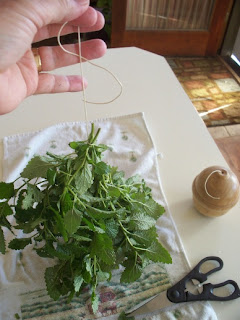
Peparing the herbs for drying.
A few weeks ago I harvested bunches of peppermint and lemon balm. I washed them, tied them into small bundles, and hung them to dry in a clean corner of our guest room. Today I took a few sprigs of the dried peppermint, crushed the leaves, and tucked them into my tea ball. After a healthy splash of hot water and a few minutes of steeping, I was rewarded with a fresh cup of peppermint tea. A very good cup of peppermint tea.

Just up the road from us in Boulder, Colorado, is the Celestial Seasonings tea factory. Every bag of Celestial Seasonings tea that you buy in this country is produced at that plant. They offer free tours and one of the highlights is the mint room. The fragrant oils in mint are so powerful that they'll affect the taste of the other tea ingredients stored in the warehouse so they store the mint in its own separate room. It's an overwhelming experience and one that will clear out your sinuses for weeks to come.

A mid-winter delight, when snow blankets the ground, is to sit in front of the fire with my wife and sip a hot cup of mint tea. Traditionally it's a Celestial Seasonings mint tea because we always seem to come home with boxes of it after visiting the factory. The cup I made today, with my own leaves, tasted just like that mid-winter brew. Actually, it tasted a little better because it was from my garden.

I certainly don't intend to put the company out of business and I'll continue to buy many of their other blends, but I was able to replicate one of their successes with one of my own. It felt good.

Mint has been part of my garden for years, but it was usually used as a garnish. In years past I intended to use it for tea, but other gardening chores always seemed to have a higher priority. I grew chamomile for the purpose of making tea, but that fell short too. This year, with focus and determination, I finally fulfilled the goal I set of making a cup of tea from my own harvest. It will be the first of many.

Too often we have plans for our plants and then time and weather intervene and upset the cart. The little successes are what makes gardening so enjoyable and I suggest you find as many successes as you can. Herbs can be the conduit to continued success. I'll continue to experiment with herb blends for tea and see what happens. That's how Celestial Seasonings started. Who knows where it will lead me or you, if you do the same.
Herbs are a great addition to any garden. They're easy to grow in a small plot or pot, add fragrance and texture to the landscape, and offer you a ticket to many culinary adventures. For me, few things are as enjoyable as a walk to my herb garden to snip off a little fresh parsley, sage, rosemary, and thyme, and toss it all into a pot of simmering tomatoes. Who knew that Simon and Garfunkel were singing about a recipe for spaghetti sauce.

In the next few days I'll harvest my sage, rosemary, and thyme, along with oregano and tarragon. After they're finished drying, I'll crumble them and fill the little glass bottles that already have printed labels on them. Those are the bottles of mass-produced herbs that I bought at the grocery store years ago. I've reused the bottles over and over again to hold my own herbs. I don't remember the last time our household purchased those common herbs; each year's harvest is enough to sustain us through the winter until fresh herbs sprout again.

This is a pattern I've followed season after season. When the tomato or pepper production suffered, the herbs were always providing useful crops. When the pumpkins or corn failed to produce adequate quantities, the herbs offered a glimmer of success. This year I decided to expand on that dependability and branch out a little.

Peparing the herbs for drying.
A few weeks ago I harvested bunches of peppermint and lemon balm. I washed them, tied them into small bundles, and hung them to dry in a clean corner of our guest room. Today I took a few sprigs of the dried peppermint, crushed the leaves, and tucked them into my tea ball. After a healthy splash of hot water and a few minutes of steeping, I was rewarded with a fresh cup of peppermint tea. A very good cup of peppermint tea.

Just up the road from us in Boulder, Colorado, is the
Celestial Seasonings tea factory. Every bag of Celestial Seasonings tea that you buy in this country is produced at that plant. They offer free tours and one of the highlights is the mint room. The fragrant oils in mint are so powerful that they'll affect the taste of the other tea ingredients stored in the warehouse so they store the mint in its own separate room. It's an overwhelming experience and one that will clear out your sinuses for weeks to come.

A mid-winter delight, when snow blankets the ground, is to sit in front of the fire with my wife and sip a hot cup of mint tea. Traditionally it's a Celestial Seasonings mint tea because we always seem to come home with boxes of it after visiting the factory. The cup I made today, with my own leaves, tasted just like that mid-winter brew. Actually, it tasted a little better because it was from my garden.

I certainly don't intend to put the company out of business and I'll continue to buy many of their other blends, but I was able to replicate one of their successes with one of my own. It felt good.

Mint has been part of my garden for years, but it was usually used as a garnish. In years past I intended to use it for tea, but other gardening chores always seemed to have a higher priority. I grew chamomile for the purpose of making tea, but that fell short too. This year, with focus and determination, I finally fulfilled the goal I set of making a cup of tea from my own harvest. It will be the first of many.

Too often we have plans for our plants and then time and weather intervene and upset the cart. The little successes are what makes gardening so enjoyable and I suggest you find as many successes as you can. Herbs can be the conduit to continued success. I'll continue to experiment with herb blends for tea and see what happens. That's how Celestial Seasonings started. Who knows where it will lead me or you, if you do the same.

Monday, September 27, 2010

Presto It's Pesto

Another gardening dream came true. For years I've grown basil, an herb that adds aroma to the garden and savory flavor to the palate. In my garden, it's never grown to abundance because I regularly pluck off leaves during the summer to pair with fresh tomatoes and mozarella cheese, a delectable salad when drizzled with balsamic vinegar. I've always wanted to make pesto, but never seemed to have enough basil to fulfill the requirements of standard recipes.

A portion of my herb garden

Today I harvested a large bowl of leaves and immediately made a classic pesto. Some pine nuts, some Turkish extra virgin olive oil that was a gift from my good friend Della, some parmigiano reggiano cheese, some garlic, and the fresh basil combined into a delicious concoction. I sliced off a small piece off crusty ciabatta bread, spread a thick layer of the pesto, took a bite, and promptly soared to heaven.

Gardening brings satisfaction and joy on many levels. Chief among the enjoyment is savoring the moments of harvest when you taste the results of your labor. The warm, ripe tomato fresh from the vine. The sweet, yellow ear of corn. The crunch and flavor of sweet peas. The exploding wetness of strawberries, raspberries, and blackberries. The slobbery mouthful of melon. And now I add the spicy freshness of basil in pesto.

I garden because I enjoy the process. I like planning and planting. I even enjoy fertilizing and weeding. But the process has an end result and that is the harvest. I've had years with only one or two tomatoes being produced. I've seen thousands of apricot blossoms frozen by a spring frost. I've had birds destroy nearly an entire season's supply of apples. I've had many green pumpkins and green tomatoes when the ground is white. Even with results that others might deem as failure, I've persevered and enjoyed doing it all over again.

Enjoying a fresh herb like I did today makes an entire year memorable. There have been many successes in my garden this summer and a few setbacks, but the good memories will remain. My first pesto only happens once. It took years to make it happen and it was well worth it.
Another gardening dream came true. For years I've grown basil, an herb that adds aroma to the garden and savory flavor to the palate. In my garden, it's never grown to abundance because I regularly pluck off leaves during the summer to pair with fresh tomatoes and mozarella cheese, a delectable salad when drizzled with balsamic vinegar. I've always wanted to make pesto, but never seemed to have enough basil to fulfill the requirements of standard recipes.

A portion of my herb garden

Today I harvested a large bowl of leaves and immediately made a classic pesto. Some pine nuts, some Turkish extra virgin olive oil that was a gift from my good friend Della, some parmigiano reggiano cheese, some garlic, and the fresh basil combined into a delicious concoction. I sliced off a small piece off crusty ciabatta bread, spread a thick layer of the pesto, took a bite, and promptly soared to heaven.

Gardening brings satisfaction and joy on many levels. Chief among the enjoyment is savoring the moments of harvest when you taste the results of your labor. The warm, ripe tomato fresh from the vine. The sweet, yellow ear of corn. The crunch and flavor of sweet peas. The exploding wetness of strawberries, raspberries, and blackberries. The slobbery mouthful of melon. And now I add the spicy freshness of basil in pesto.

I garden because I enjoy the process. I like planning and planting. I even enjoy fertilizing and weeding. But the process has an end result and that is the harvest. I've had years with only one or two tomatoes being produced. I've seen thousands of apricot blossoms frozen by a spring frost. I've had birds destroy nearly an entire season's supply of apples. I've had many green pumpkins and green tomatoes when the ground is white. Even with results that others might deem as failure, I've persevered and enjoyed doing it all over again.

Enjoying a fresh herb like I did today makes an entire year memorable. There have been many successes in my garden this summer and a few setbacks, but the good memories will remain. My first pesto only happens once. It took years to make it happen and it was well worth it.