Link to StumbleUpon

Showing posts with label Pests. Show all posts

Friday, March 1, 2013

Home Garden Crop Rotation

Growing the same crop in the same location year after year can deplete essential soil nutrients in that area, subject plants to harmful diseases, and adversely affect the crop's growth, health, and production. To avoid this, for thousands of years farmers have practiced two, soil-enhancing, growing methods. The first is allowing a field to lie fallow. Periodically after harvest, plants are turned into the soil and allowed to decompose for a year; essentially it is in-place composting.

The second method is crop rotation. Different crops are planted in different years in a single field. For home gardeners, allowing a garden to remain unplanted goes against the very essence of why we garden so practicing crop rotation to prevent a cycle of diminishing harvest is the best idea.

Crop rotation is used to keep soil from losing nutrients that a specific plant needs. A plant like corn needs a lot of nitrogen from the soil. When it is planted in the same spot repeatedly, it will ultimately deplete all available soil nitrogen, committing a slow suicide. On a commercial level, farmers add tons of nitrogen fertilizer to soil to artificially feed the plants. On a local level, home gardeners add nitrogen fertilizer to their soils when they notice reduced plant growth too.

Effective home garden crop rotation can drastically reduce the need for supplemental fertilization and helps maintain a healthy, balanced, nutrient-rich soil. For organic gardeners it is almost a must.

My garden is different each year with crop rotation

The concept of crop rotation is simple. Crop A is planted in year one, Crop B is planted in the same location in year two instead of Crop A, Crop C is planted in year three instead of Crop A or B, and so on until the cycle is repeated.

The simplest cycle is a two-crop rotation where a plant like corn is planted one year and a crop like peas is planted in the same bed the next year. Then the cycle repeats each year with corn followed by peas followed by corn followed by peas; each cycle is completed in two years. A three-crop rotation takes three years to complete. A seven-crop rotation takes seven years.

The selection of the plants for each year is the most important aspect of crop rotation. To be effective, each successive planting should grow differently than the previous planting. In the two-crop example above, corn grows in a spot, depleting soil nitrogen. The next year a legume like peas is planted to replenish soil nitrogen. Many legumes have root nodules that harbor beneficial bacteria that takes nitrogen from the air and fixes it into the soil.

Peas and similar legumes add nitrogen to soil

In a home garden, legumes are a great choice in an easy crop rotation cycle. Peas, beans, lentils, and soybeans provide a nice harvest while adding nitrogen to soil. Other plants like clover, alfalfa, and vetch don't offer a harvest, but have the same beneficial properties. I use vetch in my garden as part of my crop rotations; the vetch is attractive with pretty little purple flowers. After a season of growth that fixes nitrogen into the soil, the plants are tilled in to add additional organic material.

Vetch in my garden

I like to practice a three-year crop rotation in my garden. In recent years I've done a tomato-pea-cucumber cycle, a garlic-pea-spinach cycle, and a beet-bean-cucumber cycle. In each of those cycles I also grew vetch. Vetch can handle cold weather so I sow it in fall after I've harvested and cleaned up a bed. The vetch grows into winter and again in early spring; I turn it into the soil about six weeks before planting the new season's crops. For plants with early summer harvest, I'll sow vetch and allow it to grow during the remaining summer and early fall.

A basic three-crop cycle of sowing plants that produce nitrogen, followed by plants that are heavy nitrogen feeders, followed by plants that are light feeders is easy to start.

A four-crop cycle is also easy if you divide plants into groups. Fruiting plants like tomatoes, cucumbers, and pumpkins is one group. Leafy plants like spinach, kale, and broccoli is a second. Root vegetables like carrots, beets, and potatoes is a third. Legumes like fava beans, peas, and lentils is a fourth.

Squash will make way for another crop

Another important reason to rotate your crops is to reduce disease and pest problems. Tomato plants are very susceptible to soil-borne pests and pathogens. In the first year of planting a new bed, tomatoes often do very well, but after being in the same spot for a period of years they suddenly seem to have problems with early blight, fusarium wilt, or leaf spot. The fungus or bacteria that causes many potential tomato problems lives in soil.

Once a plant is infected it spreads that pathogen into more soil. Any new plants in the bed will become infected and help spread it further. Crop rotation breaks this cycle. An infected plant may adversely affect soil, but if there is no new plant to spread the fungus, bacteria, or virus, it will eventually diminish and no longer cause problems.

This works because the pathogens are plant specific; tomato disease will not affect corn, peas, spinach, or pumpkins. Crop rotation helps keep plant problems from becoming established in your garden. Before tomato pathogens develop, another plant like beans grow in the bed, then a plant like spinach is planted before bean problems develop.

Knowing what plants you want to grow and the most likely diseases in your region will help you determine the best cycle. Many fungi that affect tomatoes remain viable in soil past three years so a four-crop rotation is recommended. By the time tomatoes are planted again, the threat is gone.

It's important to be aware of plant families when planning and planting. Tomato, eggplants, and potatoes can be susceptible to the same pathogens. Tomatoes and peppers have similar problems. For that reason similar plant families should not be included in a crop cycle; avoid planting tomatoes and peppers or tomatoes and potatoes in the same bed within a single crop cycle.

I practice a three-crop cycle because it's easy to plan and easy to do. It reduces the potential for problems, but isn't foolproof. If I do encounter problems in a bed, like tomatoes, I'll make note and transform that bed's cycle into a four-crop or five-crop model.

Occasionally I get lazy or behind in planting and repeat crops in a bed. Problems don't automatically develop, but I do try to get back on track for the next year.

For virtually flawless results, a seven-crop cycle can be followed. There are very few pathogens or pests that will survive seven years in soil. Extra effort should be taken to insure adequate legumes are added in the sequence. If you have the space and the inclination to develop this more-complicated cycle plan, seven is the magic number.

Home garden crop rotation also provides a great opportunity to amend your garden soil. Because you're cleaning up each bed before planting a new crop, the addition of compost is easy to do as part of soil preparation before sowing or planting. Tilling in the spent plants from the previous season, like I do with vetch, also adds important organic material to soil.

Only perennials like rhubarb stay in the same spot

The combination of crop rotation and soil amending acts to maintain a healthy soil environment. Beneficial soil bacteria and organisms thrive while harmful ones diminish and the microorganisms help make soil nutrients available to plants, enhancing overall garden production.

It does take a minimal amount of extra time to plan and initiate a new crop cycle. Depending on the size of your garden you may have to forgo certain crops in some years if there isn't enough space for a complete cycle for all garden plants. I accept these limitations as a tradeoff for a better garden overall. Occasionally doing without chard or parsnips or butternut squash is okay.

Home garden crop rotation is easy to do and has many benefits. While you're planning your next garden, think about doing it a little different than last time.


Growing the same crop in the same location year after year can deplete essential soil nutrients in that area, subject plants to harmful diseases, and adversely affect the crop's growth, health, and production. To avoid this, for thousands of years farmers have practiced two, soil-enhancing, growing methods. The first is allowing a field to lie fallow. Periodically after harvest, plants are turned into the soil and allowed to decompose for a year; essentially it is in-place composting.

The second method is crop rotation. Different crops are planted in different years in a single field. For home gardeners, allowing a garden to remain unplanted goes against the very essence of why we garden so practicing crop rotation to prevent a cycle of diminishing harvest is the best idea.

Crop rotation is used to keep soil from losing nutrients that a specific plant needs. A plant like corn needs a lot of nitrogen from the soil. When it is planted in the same spot repeatedly, it will ultimately deplete all available soil nitrogen, committing a slow suicide. On a commercial level, farmers add tons of nitrogen fertilizer to soil to artificially feed the plants. On a local level, home gardeners add nitrogen fertilizer to their soils when they notice reduced plant growth too.

Effective home garden crop rotation can drastically reduce the need for supplemental fertilization and helps maintain a healthy, balanced, nutrient-rich soil. For organic gardeners it is almost a must.

My garden is different each year with crop rotation

The concept of crop rotation is simple. Crop A is planted in year one, Crop B is planted in the same location in year two instead of Crop A, Crop C is planted in year three instead of Crop A or B, and so on until the cycle is repeated.

The simplest cycle is a two-crop rotation where a plant like corn is planted one year and a crop like peas is planted in the same bed the next year. Then the cycle repeats each year with corn followed by peas followed by corn followed by peas; each cycle is completed in two years. A three-crop rotation takes three years to complete. A seven-crop rotation takes seven years.

The selection of the plants for each year is the most important aspect of crop rotation. To be effective, each successive planting should grow differently than the previous planting. In the two-crop example above, corn grows in a spot, depleting soil nitrogen. The next year a legume like peas is planted to replenish soil nitrogen. Many legumes have root nodules that harbor beneficial bacteria that takes nitrogen from the air and fixes it into the soil.

Peas and similar legumes add nitrogen to soil

In a home garden, legumes are a great choice in an easy crop rotation cycle. Peas, beans, lentils, and soybeans provide a nice harvest while adding nitrogen to soil. Other plants like clover, alfalfa, and vetch don't offer a harvest, but have the same beneficial properties. I use vetch in my garden as part of my crop rotations; the vetch is attractive with pretty little purple flowers. After a season of growth that fixes nitrogen into the soil, the plants are tilled in to add additional organic material.

Vetch in my garden

I like to practice a three-year crop rotation in my garden. In recent years I've done a tomato-pea-cucumber cycle, a garlic-pea-spinach cycle, and a beet-bean-cucumber cycle. In each of those cycles I also grew vetch. Vetch can handle cold weather so I sow it in fall after I've harvested and cleaned up a bed. The vetch grows into winter and again in early spring; I turn it into the soil about six weeks before planting the new season's crops. For plants with early summer harvest, I'll sow vetch and allow it to grow during the remaining summer and early fall.

A basic three-crop cycle of sowing plants that produce nitrogen, followed by plants that are heavy nitrogen feeders, followed by plants that are light feeders is easy to start.

A four-crop cycle is also easy if you divide plants into groups. Fruiting plants like tomatoes, cucumbers, and pumpkins is one group. Leafy plants like spinach, kale, and broccoli is a second. Root vegetables like carrots, beets, and potatoes is a third. Legumes like fava beans, peas, and lentils is a fourth.

Squash will make way for another crop

Another important reason to rotate your crops is to reduce disease and pest problems. Tomato plants are very susceptible to soil-borne pests and pathogens. In the first year of planting a new bed, tomatoes often do very well, but after being in the same spot for a period of years they suddenly seem to have problems with early blight, fusarium wilt, or leaf spot. The fungus or bacteria that causes many potential tomato problems lives in soil.

Once a plant is infected it spreads that pathogen into more soil. Any new plants in the bed will become infected and help spread it further. Crop rotation breaks this cycle. An infected plant may adversely affect soil, but if there is no new plant to spread the fungus, bacteria, or virus, it will eventually diminish and no longer cause problems.

This works because the pathogens are plant specific; tomato disease will not affect corn, peas, spinach, or pumpkins. Crop rotation helps keep plant problems from becoming established in your garden. Before tomato pathogens develop, another plant like beans grow in the bed, then a plant like spinach is planted before bean problems develop.

Knowing what plants you want to grow and the most likely diseases in your region will help you determine the best cycle. Many fungi that affect tomatoes remain viable in soil past three years so a four-crop rotation is recommended. By the time tomatoes are planted again, the threat is gone.

It's important to be aware of plant families when planning and planting. Tomato, eggplants, and potatoes can be susceptible to the same pathogens. Tomatoes and peppers have similar problems. For that reason similar plant families should not be included in a crop cycle; avoid planting tomatoes and peppers or tomatoes and potatoes in the same bed within a single crop cycle.

I practice a three-crop cycle because it's easy to plan and easy to do. It reduces the potential for problems, but isn't foolproof. If I do encounter problems in a bed, like tomatoes, I'll make note and transform that bed's cycle into a four-crop or five-crop model.

Occasionally I get lazy or behind in planting and repeat crops in a bed. Problems don't automatically develop, but I do try to get back on track for the next year.

For virtually flawless results, a seven-crop cycle can be followed. There are very few pathogens or pests that will survive seven years in soil. Extra effort should be taken to insure adequate legumes are added in the sequence. If you have the space and the inclination to develop this more-complicated cycle plan, seven is the magic number.

Home garden crop rotation also provides a great opportunity to amend your garden soil. Because you're cleaning up each bed before planting a new crop, the addition of compost is easy to do as part of soil preparation before sowing or planting. Tilling in the spent plants from the previous season, like I do with vetch, also adds important organic material to soil.

Only perennials like rhubarb stay in the same spot

The combination of crop rotation and soil amending acts to maintain a healthy soil environment. Beneficial soil bacteria and organisms thrive while harmful ones diminish and the microorganisms help make soil nutrients available to plants, enhancing overall garden production.

It does take a minimal amount of extra time to plan and initiate a new crop cycle. Depending on the size of your garden you may have to forgo certain crops in some years if there isn't enough space for a complete cycle for all garden plants. I accept these limitations as a tradeoff for a better garden overall. Occasionally doing without chard or parsnips or butternut squash is okay.

Home garden crop rotation is easy to do and has many benefits. While you're planning your next garden, think about doing it a little different than last time.


Monday, May 9, 2011

Ants In My Plants

Ants become visible in the spring after spending the winter underground and can raise concern among gardeners. In the last week I've been asked by three different gardeners about the sudden explosion of ants in their gardens. Unless you happen to live next to an atomic bomb test range in New Mexico, you shouldn't be too concerned about ants, even big ones.

Carpenter ants in my firewood

Most ants are beneficial. They control pests like caterpillars and termites, eat weed seeds, and can improve soil with their tunnels and nests. They clean up plant debris and dead insect bodies. They can help pollinate flowers. They'll move flower seeds, giving them a chance to germinate in a new location. They're an important part of the ecosystem in your garden.

Of course, it's not all good. They can create a colony underneath your favorite plants and produce an unsightly mound. They'll eat plants and roots that are in their way. Some ants will corral aphids and actually protect them as they suck the sap from your plants; the ants feed on the excretion of the aphids, a "honeydew" sweet liquid that ants love. They can invade your home seeking food. Seeing ants in places you don't expect to see them can be a little unnerving, but they're not all bad; California has over 200 species of ants, and only considers less than a dozen as pests.

Dealing with ants is a good opportunity to practice Integrated Pest Management (see my blog,"Integrating Integrated Pest Management"). First determine if the ants really are a problem in your garden. If they're just walking around, checking out the area after waking up, then leaving them alone is easy. If you see a large mass of ants, don't panic, wait and see where they go and what they do; they may just be moving to a new home.

I rarely try to kill or reduce the number of ants in my yard. When I do, it's usually because large numbers have moved into a territory that I've identified for another purpose, like the middle of a vegetable bed. As long as it's not a harmful species like fire ants, disturbing the nest with a shovel may be enough for the little creatures to grab their eggs and move elsewhere. (Important note: if you really have fire ants, they should be reported to your county agriculture agent for identification and control).

If you begin to see actual plant damage due to ants or the aphids they're cowboying, it may be time for action. If they're in a location that is a problem, you probably want them gone. Take some time to determine where their nest is. This may mean following a line of ants, or even a single one, until it leads you to its home.

You may not need to kill a single ant to alleviate your problem. Ants seek out food and then return home by following a scent trail that they made. By disrupting the scent trail you can reduce the likelihood that the ants will return to the food source, like your kitchen. Soapy water will work; sponge off the area that the ant was walking to eliminate the trail. Outside you can spray it with a hose, but plain water is not completely effective, so using a bucket of soapy water is better.

For best control realize that you need to deal with the ants that you can't see. Spraying or dealing with the few on your plants or in your kitchen won't remove the problem. You need to choose a method that attacks them in the nest.

If you feel you need to eliminate the nest, you can use a few methods that are not completely toxic. Diatomaceous earth will act to desiccate the ants and kill them. It's commonly used to control slugs and snails so you just may have some in your garden shed. Sprinkle it around your garden beds and the ant nest.

You can make your own ant poison by mixing boric acid with sugar, honey, or jelly. Place it near the nest to avoid attracting other ants to the area you're trying to clear.

If you decide to use a commercial ant poison you should identify what kind of ants you have. Each region can have dozens of different species and some are easier to remove or kill than others. Ants generally look alike, but upon close examination you'll see that some are brown or black while others are yellow or red. You also want to be sure you don't actually have termites, which are often confused with ants. Do an online or library search to identify the species you're dealing with.  The University of California, Davis has an online key (see the link below).

The reason for identification is that different ants react differently to the standard ant poison you can buy. While the poison may kill many of the ants in a garden, it won't kill all types and may actually cause some to move from the original location to other areas, like under or in your house.

Generally, ant baits work better at killing ants in the nest than pesticide sprays. The sprays will only affect the ants that come into direct contact with the pesticide while the baits will be carried into the nest by workers and transferred mouth to mouth and ultimately kill most of the ants.

The initial reaction by many people when they see ants is to want to kill them. I recommend that you stop and analyze their effect on your garden. Chances are they're having a beneficial effect. Don't assume that they're causing a problem. Even if there is a problem, don't rush to kill all of the ants. Ants are an important component in a garden's life force and eliminating them may disrupt the natural circle.

If you choose to take drastic action, practice smart pesticide practice. Deal with the ants directly and don't wantonly distribute harmful chemicals in your garden.

Be aware that there are ants throughout the world. The attractions that brought ants to your garden are still present and removing a nest just opens up space for different ants to move in. Once you begin trying to control ants, you may start a course of action that takes up a lot of your gardening time.


Link to my blog,"Integrating Integrated Pest Management".
The University of California, Davis online key here


Ants become visible in the spring after spending the winter underground and can raise concern among gardeners. In the last week I've been asked by three different gardeners about the sudden explosion of ants in their gardens. Unless you happen to live next to an atomic bomb test range in New Mexico, you shouldn't be too concerned about ants, even big ones.

Carpenter ants in my firewood

Most ants are beneficial. They control pests like caterpillars and termites, eat weed seeds, and can improve soil with their tunnels and nests. They clean up plant debris and dead insect bodies. They can help pollinate flowers. They'll move flower seeds, giving them a chance to germinate in a new location. They're an important part of the ecosystem in your garden.

Of course, it's not all good. They can create a colony underneath your favorite plants and produce an unsightly mound. They'll eat plants and roots that are in their way. Some ants will corral aphids and actually protect them as they suck the sap from your plants; the ants feed on the excretion of the aphids, a "honeydew" sweet liquid that ants love. They can invade your home seeking food. Seeing ants in places you don't expect to see them can be a little unnerving, but they're not all bad; California has over 200 species of ants, and only considers less than a dozen as pests.

Dealing with ants is a good opportunity to practice Integrated Pest Management (see my blog,"Integrating Integrated Pest Management"). First determine if the ants really are a problem in your garden. If they're just walking around, checking out the area after waking up, then leaving them alone is easy. If you see a large mass of ants, don't panic, wait and see where they go and what they do; they may just be moving to a new home.

I rarely try to kill or reduce the number of ants in my yard. When I do, it's usually because large numbers have moved into a territory that I've identified for another purpose, like the middle of a vegetable bed. As long as it's not a harmful species like fire ants, disturbing the nest with a shovel may be enough for the little creatures to grab their eggs and move elsewhere. (Important note: if you really have fire ants, they should be reported to your county agriculture agent for identification and control).

If you begin to see actual plant damage due to ants or the aphids they're cowboying, it may be time for action. If they're in a location that is a problem, you probably want them gone. Take some time to determine where their nest is. This may mean following a line of ants, or even a single one, until it leads you to its home.

You may not need to kill a single ant to alleviate your problem. Ants seek out food and then return home by following a scent trail that they made. By disrupting the scent trail you can reduce the likelihood that the ants will return to the food source, like your kitchen. Soapy water will work; sponge off the area that the ant was walking to eliminate the trail. Outside you can spray it with a hose, but plain water is not completely effective, so using a bucket of soapy water is better.

For best control realize that you need to deal with the ants that you can't see. Spraying or dealing with the few on your plants or in your kitchen won't remove the problem. You need to choose a method that attacks them in the nest.

If you feel you need to eliminate the nest, you can use a few methods that are not completely toxic. Diatomaceous earth will act to desiccate the ants and kill them. It's commonly used to control slugs and snails so you just may have some in your garden shed. Sprinkle it around your garden beds and the ant nest.

You can make your own ant poison by mixing boric acid with sugar, honey, or jelly. Place it near the nest to avoid attracting other ants to the area you're trying to clear.

If you decide to use a commercial ant poison you should identify what kind of ants you have. Each region can have dozens of different species and some are easier to remove or kill than others. Ants generally look alike, but upon close examination you'll see that some are brown or black while others are yellow or red. You also want to be sure you don't actually have termites, which are often confused with ants. Do an online or library search to identify the species you're dealing with.  The University of California, Davis has an online key (see the link below).

The reason for identification is that different ants react differently to the standard ant poison you can buy. While the poison may kill many of the ants in a garden, it won't kill all types and may actually cause some to move from the original location to other areas, like under or in your house.

Generally, ant baits work better at killing ants in the nest than pesticide sprays. The sprays will only affect the ants that come into direct contact with the pesticide while the baits will be carried into the nest by workers and transferred mouth to mouth and ultimately kill most of the ants.

The initial reaction by many people when they see ants is to want to kill them. I recommend that you stop and analyze their effect on your garden. Chances are they're having a beneficial effect. Don't assume that they're causing a problem. Even if there is a problem, don't rush to kill all of the ants. Ants are an important component in a garden's life force and eliminating them may disrupt the natural circle.

If you choose to take drastic action, practice smart pesticide practice. Deal with the ants directly and don't wantonly distribute harmful chemicals in your garden.

Be aware that there are ants throughout the world. The attractions that brought ants to your garden are still present and removing a nest just opens up space for different ants to move in. Once you begin trying to control ants, you may start a course of action that takes up a lot of your gardening time.


Link to my blog,"
Integrating Integrated Pest Management".
The University of California, Davis online key here


Tuesday, March 8, 2011

Integrating Integrated Pest Management

You have insects in your garden. You have weeds. You may have gophers, squirrels, cats, or any other animal that can adversely affect your plants. How do you deal with pests in your garden? Do you take the "shotgun" approach where you wantonly wreak destruction to terminate the pest, or do you take the "sniper" approach where you target the specific pest and handle it with surgical precision?

A well-managed garden has little need for chemicals.

Many gardeners are quick to act when their garden is threatened and in the process of dealing with a pest they unknowingly create more problems. In an effort to kill an insect that is chewing leaves they may inadvertently kill ladybugs or honey bees that are beneficial to plants. By trying to poison gophers or mice they may harm pets or children. Eradicating weeds with herbicides may hinder the growth of the very plants they're trying to protect.

Integrated Pest Management (or IPM) is a common sense approach to dealing with pests through economical and appropriate responses. IPM is safe, effective, and scientific. It's a way of looking at your gardening decisions by thinking beyond the immediate threat and considering how your actions will affect your entire garden.

The U.S. Environmental Protection Agency (www.EPA.gov) identifies a four-step IPM process when dealing with pests.

The first step is to Set Action Thresholds. This means you should determine the point at which the pest becomes a problem and you need to act. Not every pest requires immediate action. Spotting a single Tobacco Hornworm on your tomato plant, accompanied by a few chewed leaves, is cause for some concern, but not enough to hire an exterminator to spray your entire garden with pesticides. When plants are defoliated you've waited too long. You have to determine when it's appropriate to deal with a pest.

The second step is to Monitor and Identify Pests. Not every insect is a bad one. And even the bad ones may have natural enemies looking for lunch. A few Tobacco Hornworms can be knocked off by you, your chickens, wild birds, or certain wasps. The reason to monitor and identify pests is for you to slow down and think about appropriate control before jumping too quickly to a decision of using pesticides or herbicides. There are many insects that may seem threatening at first, but after identification turn out to be beneficial bugs.

An important aspect of IPM is Prevention. This is the first-line of defense against pests. This requires some education on your part so you understand potential pests and how they can be deterred. If Tobacco Hornworms are a problem for your tomatoes, learning about wasp parasitoids is important. They naturally kill the Hornworm larvae and you constructing wasp shelters and nesting boxes may be worth the effort; the adult moths can be trapped in light traps. For other pests, rotating crops, mulching, fencing, choosing appropriate plant varieties, and encouraging beneficial predators are all possible actions in your garden. Chemicals are rarely a preventative measure.

Control is the final step of IPM. If prevention isn't working or isn't available, and if the problem has exceeded your Action Threshold, it's time to deal with the pest directly. If your hornworms are multiplying and causing excessive damage it's time to attack the culprit, but you should take proper control action. Try the least risky option first; broadcast spraying of pesticides is a last resort. You and your army of kids can march into your tomato plants to pluck off the caterpillars and scrape off the eggs. Try a bacterial control like Bacillus thuringiensis before insecticides; it won't harm most beneficial insects. If you opt for a chemical insecticide, use it only on the plants that are affected, not your entire garden.

The idea behind Integrated Pest Management is is continually monitor your garden through all four steps and act appropriately. Specific pests require specific prevention and control. There is no single solution to deal with all pests, all of the time. You want to minimize pest damage while minimizing environmental damage.

Moths and butterflies are nice to look at but their caterpillars may be harmful.

There are many control actions for different pests. Mechanical control is you taking physical action: plucking off that hornworm; pulling a weed; pruning off a diseased branch. Cultural control is the way you prevent pests: putting up a fence to keep rabbits out; pruning branches to increase airflow and decrease powdery mildew; planting disease-resistant varieties. Biological control is using natural predators: encouraging ladybugs to eat aphids; letting your chickens forage for grubs and larvae; allowing birds in your garden to eat caterpillars. Chemical control is selecting appropriate chemicals for pests: spraying glyphosate (usually Roundup) on perennial weeds at the proper time of year; applying a fungicide when cultural practice was insufficient; not applying pesticides by the calendar, but only when needed.

Proper pruning lets in air and light and reduces fungal disease.

The concept of Integrated Pest management may sound daunting, but it is simple in practice. Educate yourself about how different insects, plants, and animals react to each other in regard to your garden. Try to avoid reaching for a chemical spray and think about natural or cultural alternatives to pest control. This isn't organic gardening, but an approach to using appropriate measures for specific problems.

Commercial growers are learning that IPM is a cost-effective way to manage pests. You can find that the same cost-effective principles will work in your garden. They do in mine.
You have insects in your garden. You have weeds. You may have gophers, squirrels, cats, or any other animal that can adversely affect your plants. How do you deal with pests in your garden? Do you take the "shotgun" approach where you wantonly wreak destruction to terminate the pest, or do you take the "sniper" approach where you target the specific pest and handle it with surgical precision?

A well-managed garden has little need for chemicals.

Many gardeners are quick to act when their garden is threatened and in the process of dealing with a pest they unknowingly create more problems. In an effort to kill an insect that is chewing leaves they may inadvertently kill ladybugs or honey bees that are beneficial to plants. By trying to poison gophers or mice they may harm pets or children. Eradicating weeds with herbicides may hinder the growth of the very plants they're trying to protect.

Integrated Pest Management (or IPM) is a common sense approach to dealing with pests through economical and appropriate responses. IPM is safe, effective, and scientific. It's a way of looking at your gardening decisions by thinking beyond the immediate threat and considering how your actions will affect your entire garden.

The U.S. Environmental Protection Agency (www.EPA.gov) identifies a four-step IPM process when dealing with pests.

The first step is to Set Action Thresholds. This means you should determine the point at which the pest becomes a problem and you need to act. Not every pest requires immediate action. Spotting a single Tobacco Hornworm on your tomato plant, accompanied by a few chewed leaves, is cause for some concern, but not enough to hire an exterminator to spray your entire garden with pesticides. When plants are defoliated you've waited too long. You have to determine when it's appropriate to deal with a pest.

The second step is to Monitor and Identify Pests. Not every insect is a bad one. And even the bad ones may have natural enemies looking for lunch. A few Tobacco Hornworms can be knocked off by you, your chickens, wild birds, or certain wasps. The reason to monitor and identify pests is for you to slow down and think about appropriate control before jumping too quickly to a decision of using pesticides or herbicides. There are many insects that may seem threatening at first, but after identification turn out to be beneficial bugs.

An important aspect of IPM is Prevention. This is the first-line of defense against pests. This requires some education on your part so you understand potential pests and how they can be deterred. If Tobacco Hornworms are a problem for your tomatoes, learning about wasp parasitoids is important. They naturally kill the Hornworm larvae and you constructing wasp shelters and nesting boxes may be worth the effort; the adult moths can be trapped in light traps. For other pests, rotating crops, mulching, fencing, choosing appropriate plant varieties, and encouraging beneficial predators are all possible actions in your garden. Chemicals are rarely a preventative measure.

Control is the final step of IPM. If prevention isn't working or isn't available, and if the problem has exceeded your Action Threshold, it's time to deal with the pest directly. If your hornworms are multiplying and causing excessive damage it's time to attack the culprit, but you should take proper control action. Try the least risky option first; broadcast spraying of pesticides is a last resort. You and your army of kids can march into your tomato plants to pluck off the caterpillars and scrape off the eggs. Try a bacterial control like Bacillus thuringiensis before insecticides; it won't harm most beneficial insects. If you opt for a chemical insecticide, use it only on the plants that are affected, not your entire garden.

The idea behind Integrated Pest Management is is continually monitor your garden through all four steps and act appropriately. Specific pests require specific prevention and control. There is no single solution to deal with all pests, all of the time. You want to minimize pest damage while minimizing environmental damage.

Moths and butterflies are nice to look at but their caterpillars may be harmful.

There are many control actions for different pests. Mechanical control is you taking physical action: plucking off that hornworm; pulling a weed; pruning off a diseased branch. Cultural control is the way you prevent pests: putting up a fence to keep rabbits out; pruning branches to increase airflow and decrease powdery mildew; planting disease-resistant varieties. Biological control is using natural predators: encouraging ladybugs to eat aphids; letting your chickens forage for grubs and larvae; allowing birds in your garden to eat caterpillars. Chemical control is selecting appropriate chemicals for pests: spraying glyphosate (usually Roundup) on perennial weeds at the proper time of year; applying a fungicide when cultural practice was insufficient; not applying pesticides by the calendar, but only when needed.

Proper pruning lets in air and light and reduces fungal disease.

The concept of Integrated Pest management may sound daunting, but it is simple in practice. Educate yourself about how different insects, plants, and animals react to each other in regard to your garden. Try to avoid reaching for a chemical spray and think about natural or cultural alternatives to pest control. This isn't organic gardening, but an approach to using appropriate measures for specific problems.

Commercial growers are learning that IPM is a cost-effective way to manage pests. You can find that the same cost-effective principles will work in your garden. They do in mine.

Monday, February 28, 2011

Pets in the Garden

It seems many gardeners spend great effort to rid their gardens of deer, rabbits, squirrels, gophers, bears, and birds. How much similar effort is taken to reduce the damage of our house pets? Or do we just accept their incursions because we enjoy and are thankful for their companionship?

For me, gardening with one of my "garden buddies" adds to my enjoyment. I wrote of losing my Shaca at Thanksgiving. She was inseparable from me and was always a fixture in my gardens as I worked. Before her, my dog Stranger helped supervise my efforts. Both of them loved to lie in a fresh garden bed and enjoy the cool soil when I allowed the opportunity. Now our new puppy Lily is beginning to take an interest in gardening.

Lily helping me develop more garden beds.

An important aspect of gardening with pets is to make the effort to train them for appropriate behavior. If your dog knows the command to get off the furniture, it's little effort to modify that training to get out of a raised bed; I worked with Lily on that and she learned quickly. If you've trained them to drop a ball or a shoe, it's easy for them to drop a garden glove or tomato when given the command. If they know to not eat the people food on the table, they'll learn not to eat the people food in the garden.

Recognize that animals don't instinctively understand the concept of borders or expensive flowers or "wait until harvest." When Shaca was young she loved to run into the house with a big green tomato in her mouth. For her it was just like a tennis ball and she was ready to play, but for me it was another ravaged tomato. With concerted effort I was able to train her to leave the tomatoes alone and never again had that problem.

For one beautification project I constructed a little winding stone path that led to the vegetable garden gate and fully expected the dogs to figure it out. They never did. When running to the gate they took a straight-line approach through whatever plants were in their way. I lessened the impact on some perennial beds by planting sturdy, prickly bushes like Barberry in the most obvious intersections of their travels. Stone benches and big pots worked in other places.

Recognizing their patterns can help. At our new house I took the time to identify the paths they travel. This time when I put in a stone path I placed it on top of the path they had worn into the lawn. I reduced the damage to the grass, added a decorative path, and let their tendencies affect my plans.

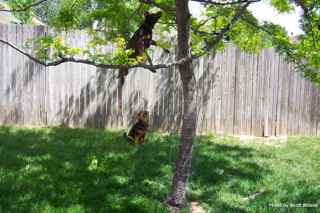
Years ago I made many attempts to grow shade plants at the base of a big Silver Maple in the backyard. One day I spent the entire morning planting ground covers and low flowers. I ran to the nursery for more flowers and upon my return witnessed devastation. There was no sign that a single plant ever existed in that space. A squirrel entered the tree shortly after my departure and Shaca spent the entire time leaping for the squirrel and ripping out the plantings in the process. I soon abandoned trying to grow anything there except in pots. When it came to squirrels and that tree, there was no stopping Shaca's enthusiasm.

Shaca jumping for a squirrel in the locust tree.

You can remedy most situations by anticipating that damage will happen. I fenced my previous vegetable garden to keep the dogs out, except when I was with them. A fence goes up around my new vegetable garden soon. They'll leave the tomatoes alone and stay out of the beds when they know you're looking, but when on the trail of a scent in your absence they don't pause to think about their course. A low fence is all you need to keep pets where you want them.

It's easier to break bad habits by not encouraging them. It's fun to watch a young dog dig a hole with passion, but they don't understand the difference between a bare spot that is being tilled and a treasured bed filled with imported lilies; digging is just digging to them so don't let it start. Few things are as disgusting as being on your hands and knees planting bulbs and finding a cat's "gift" deposited in the soil beneath your fingers. If you have a cat, take every effort to let them know that the garden isn't a bathroom.

You can ensure zero damage by leaving pets in the house or in a fenced run and never letting them roam the yard. That's an option, but not one to which I adhere. My deer problem is not as bad as it could be because our dogs roam, leave their scent, and make their presence known. Though Shaca caused some damage chasing squirrels, I never had the squirrels cause any damage to my plants.

Having pets in your garden is about creating a partnership. You're the senior partner and it's up to you to set the rules. By being firm with your training you can develop a sense of protection in your pet. Your dog will chase away the birds raiding your strawberries or the deer chewing your bushes. Shaca accidentally dug up one of my young lavenders once, but it was because she did a great shop digging for gophers and limiting their incursions in the garden.

Shaca and Zeffer on watch by the raspberries.

My personal focus is on dogs because that's what we have. Geese can be great protectors of your yard. Chickens will rid your garden of insects and weeds. Cats are known for their abilities to keep vermin at bay. Whatever your pet, let them be part of your gardening experience.

I know of gardeners who truly partner with their pets while gardening. Their dog will carry tools or vegetables in a pack. Dogs can pull carts and be taught to pull hoses. I haven't tried that yet and probably won't, but if you have the training skills it may be worth the effort.

Take the time to think about how you garden and how your pets are part of it. With a little effort you can make it more rewarding than it is now. I'm looking forward to gardening with Lily. And I'm sure she'll enjoy it too.
It seems many gardeners spend great effort to rid their gardens of deer, rabbits, squirrels, gophers, bears, and birds. How much similar effort is taken to reduce the damage of our house pets? Or do we just accept their incursions because we enjoy and are thankful for their companionship?

For me, gardening with one of my "garden buddies" adds to my enjoyment. I wrote of losing my Shaca at Thanksgiving. She was inseparable from me and was always a fixture in my gardens as I worked. Before her, my dog Stranger helped supervise my efforts. Both of them loved to lie in a fresh garden bed and enjoy the cool soil when I allowed the opportunity. Now our new puppy Lily is beginning to take an interest in gardening.

Lily helping me develop more garden beds.

An important aspect of gardening with pets is to make the effort to train them for appropriate behavior. If your dog knows the command to get off the furniture, it's little effort to modify that training to get out of a raised bed; I worked with Lily on that and she learned quickly. If you've trained them to drop a ball or a shoe, it's easy for them to drop a garden glove or tomato when given the command. If they know to not eat the people food on the table, they'll learn not to eat the people food in the garden.

Recognize that animals don't instinctively understand the concept of borders or expensive flowers or "wait until harvest." When Shaca was young she loved to run into the house with a big green tomato in her mouth. For her it was just like a tennis ball and she was ready to play, but for me it was another ravaged tomato. With concerted effort I was able to train her to leave the tomatoes alone and never again had that problem.

For one beautification project I constructed a little winding stone path that led to the vegetable garden gate and fully expected the dogs to figure it out. They never did. When running to the gate they took a straight-line approach through whatever plants were in their way. I lessened the impact on some perennial beds by planting sturdy, prickly bushes like Barberry in the most obvious intersections of their travels. Stone benches and big pots worked in other places.

Recognizing their patterns can help. At our new house I took the time to identify the paths they travel. This time when I put in a stone path I placed it on top of the path they had worn into the lawn. I reduced the damage to the grass, added a decorative path, and let their tendencies affect my plans.

Years ago I made many attempts to grow shade plants at the base of a big Silver Maple in the backyard. One day I spent the entire morning planting ground covers and low flowers. I ran to the nursery for more flowers and upon my return witnessed devastation. There was no sign that a single plant ever existed in that space. A squirrel entered the tree shortly after my departure and Shaca spent the entire time leaping for the squirrel and ripping out the plantings in the process. I soon abandoned trying to grow anything there except in pots. When it came to squirrels and that tree, there was no stopping Shaca's enthusiasm.

Shaca jumping for a squirrel in the locust tree.

You can remedy most situations by anticipating that damage will happen. I fenced my previous vegetable garden to keep the dogs out, except when I was with them. A fence goes up around my new vegetable garden soon. They'll leave the tomatoes alone and stay out of the beds when they know you're looking, but when on the trail of a scent in your absence they don't pause to think about their course. A low fence is all you need to keep pets where you want them.

It's easier to break bad habits by not encouraging them. It's fun to watch a young dog dig a hole with passion, but they don't understand the difference between a bare spot that is being tilled and a treasured bed filled with imported lilies; digging is just digging to them so don't let it start. Few things are as disgusting as being on your hands and knees planting bulbs and finding a cat's "gift" deposited in the soil beneath your fingers. If you have a cat, take every effort to let them know that the garden isn't a bathroom.

You can ensure zero damage by leaving pets in the house or in a fenced run and never letting them roam the yard. That's an option, but not one to which I adhere. My deer problem is not as bad as it could be because our dogs roam, leave their scent, and make their presence known. Though Shaca caused some damage chasing squirrels, I never had the squirrels cause any damage to my plants.

Having pets in your garden is about creating a partnership. You're the senior partner and it's up to you to set the rules. By being firm with your training you can develop a sense of protection in your pet. Your dog will chase away the birds raiding your strawberries or the deer chewing your bushes. Shaca accidentally dug up one of my young lavenders once, but it was because she did a great shop digging for gophers and limiting their incursions in the garden.

Shaca and Zeffer on watch by the raspberries.

My personal focus is on dogs because that's what we have. Geese can be great protectors of your yard. Chickens will rid your garden of insects and weeds. Cats are known for their abilities to keep vermin at bay. Whatever your pet, let them be part of your gardening experience.

I know of gardeners who truly partner with their pets while gardening. Their dog will carry tools or vegetables in a pack. Dogs can pull carts and be taught to pull hoses. I haven't tried that yet and probably won't, but if you have the training skills it may be worth the effort.

Take the time to think about how you garden and how your pets are part of it. With a little effort you can make it more rewarding than it is now. I'm looking forward to gardening with Lily. And I'm sure she'll enjoy it too.

Monday, November 22, 2010

Birds of a Feather Hungrily Flock Together

Birds and gardening go together like rednecks and NASCAR (no disrespect intended). The activity of one brings out thousands of the other. To me that's a good thing. I'm a great lover of wildlife as part of the landscape and do what I can to encourage it, especially birds. Recently my gardens were designated a "Certified Wildlife Habitat" by the National Wildlife Federation. Now, even more than before, I make a point to recognize what is happening in my yard as it pertains to wildlife.


Imagine my surprise and delight when on a chilly weekend morning I observed dozens of birds grazing through my garden simultaneously. I recognized four of the types right away. The dark-headed Steller's Jays were swooping into the crowd and out again before they picked momentary fights with each other. The Black-billed Magpies fed on the fringes and would glide majestically from one border to the other over the heads of the lesser birds. A solitary Northern Flicker woodpecker was poking his long beak into the soil as though it was the side of a tall pine. A pair of Mourning Doves bobbed in the grass walking side by side.

Initially I wasn't able to identify the birds that populated the majority of the flock. After an online search it appears that they were European Starlings. They waddled in a large group combing through the grass and twigs seeking out seeds. Their chunky bodies and short tails looked out of place among the more graceful blue and gray birds.

All of these birds and many others have fed on my seeds, berries, and insects before, but this was the first time I noticed so many different types feeding at the same time in the same place. They focused their attention beneath the forest of dried sunflowers, but spread out over the entire space of my vegetable garden. Apparently there are still many seeds sprinkled on the ground and they fed at the smorgasbord with no regard to the color of their neighbor. That by itself is a wonderful moral of the story.

My attention, however, was on the fact that at the end of November my garden is still providing sustenance for wildlife. I haven't hacked away any of my seed-bearing flowers or weeds. Some of the withered vegetables are still lying in the raised beds or on the paths between. There's little doubt that recent warm weather has allowed insects to remain active on the soil surface. All of this gives ample culinary opportunities to varieties of birds.

I found it intriguing that none of this great flock was feeding from the hanging feeder or bowl of seed resting scant feet away. On that morning they preferred to search at ground level. Maybe the insects were active, maybe the older seeds tasted better, maybe they needed the exercise. Whatever the reason, it was a marvelous sight.

That's what gardening and having habitats for wildlife is all about -- marveling at what you've created. All of those birds had other places they could have fed, but they chose my garden on that morning both individually and as a group. It was a place they felt was abundant and safe. I was enthralled by the experience so much that I didn't think to photograph it. I'll try to rectify that in the future.

What have you created for your birds? Gardens can be designed to attract specific species, like hummingbirds. They can also be designed to attract a myriad of species, as mine do. As you think about spring plantings and garden design for next year, I encourage you think about the birds. Add a flower or shrub or grass that will benefit an avian friend. It's easy to do and when you see the results you'll have those moments of wonder. It's another way to add variety and multi-season enjoyment to your garden.
Birds and gardening go together like rednecks and NASCAR (no disrespect intended). The activity of one brings out thousands of the other. To me that's a good thing. I'm a great lover of wildlife as part of the landscape and do what I can to encourage it, especially birds. Recently my gardens were designated a "Certified Wildlife Habitat" by the National Wildlife Federation. Now, even more than before, I make a point to recognize what is happening in my yard as it pertains to wildlife.


Imagine my surprise and delight when on a chilly weekend morning I observed dozens of birds grazing through my garden simultaneously. I recognized four of the types right away. The dark-headed Steller's Jays were swooping into the crowd and out again before they picked momentary fights with each other. The Black-billed Magpies fed on the fringes and would glide majestically from one border to the other over the heads of the lesser birds. A solitary Northern Flicker woodpecker was poking his long beak into the soil as though it was the side of a tall pine. A pair of Mourning Doves bobbed in the grass walking side by side.

Initially I wasn't able to identify the birds that populated the majority of the flock. After an online search it appears that they were European Starlings. They waddled in a large group combing through the grass and twigs seeking out seeds. Their chunky bodies and short tails looked out of place among the more graceful blue and gray birds.

All of these birds and many others have fed on my seeds, berries, and insects before, but this was the first time I noticed so many different types feeding at the same time in the same place. They focused their attention beneath the forest of dried sunflowers, but spread out over the entire space of my vegetable garden. Apparently there are still many seeds sprinkled on the ground and they fed at the smorgasbord with no regard to the color of their neighbor. That by itself is a wonderful moral of the story.

My attention, however, was on the fact that at the end of November my garden is still providing sustenance for wildlife. I haven't hacked away any of my seed-bearing flowers or weeds. Some of the withered vegetables are still lying in the raised beds or on the paths between. There's little doubt that recent warm weather has allowed insects to remain active on the soil surface. All of this gives ample culinary opportunities to varieties of birds.

I found it intriguing that none of this great flock was feeding from the hanging feeder or bowl of seed resting scant feet away. On that morning they preferred to search at ground level. Maybe the insects were active, maybe the older seeds tasted better, maybe they needed the exercise. Whatever the reason, it was a marvelous sight.

That's what gardening and having habitats for wildlife is all about -- marveling at what you've created. All of those birds had other places they could have fed, but they chose my garden on that morning both individually and as a group. It was a place they felt was abundant and safe. I was enthralled by the experience so much that I didn't think to photograph it. I'll try to rectify that in the future.

What have you created for your birds? Gardens can be designed to attract specific species, like hummingbirds. They can also be designed to attract a myriad of species, as mine do. As you think about spring plantings and garden design for next year, I encourage you think about the birds. Add a flower or shrub or grass that will benefit an avian friend. It's easy to do and when you see the results you'll have those moments of wonder. It's another way to add variety and multi-season enjoyment to your garden.

Monday, November 1, 2010

Not Sheep, Sherlock

There's a great new show this season as part of "Masterpiece Theater" on PBS. Based on Sir Arthur Conan Doyle’s master detective, "Sherlock" places Sherlock Holmes and Dr. John Watson in present-day London. Even in modern times, the eccentric Sherlock can deduce multitudes of information from the smallest clues. It appears miraculous, but is a skill most people can learn. Gardeners regularly rely on deductive reasoning as part of normal activities.

Today I was forced to play the detective in my own backyard. Last week I noticed the tips of the raspberry canes were gone. Not shriveled from the cold weather, but sheared off. My first inclination was to think that birds were the culprits, pecking off the few berries that were forming. I wasn't planning to harvest the cold-damaged fruit, so wasn't very concerned by it. It was more of an anomoly that left me scratching my head.

A few days ago I noticed that the buds on the branch tips of the new cherry tree had been eaten off. Again, I briefly suspected birds, but also wondered if squirrels might be the pests. They'll eat tree buds for food, though that typically happens in winter. My biggest concern was for the tree. I have four-foot tall wire cages around them to keep the dogs and grandchildren away, but with the tree tips gone, future vertical growth will be hampered. The apple tree I planted this year showed similar damage too.

Yesterday I noticed a large section of bark was removed from an aspen tree within spitting distance of the fruit trees. The torn bark was a few feet off the ground and my first reaction was that a porcupine had moved through the area. I've seen porcupine damage before and from the window it showed the same traits. It isn't out of the question because one of our dogs was quilled in our back yard a number of years back.

Today I decided to take a closer look and try to deduce what happened. Students of deductive reasoning know that the simplest answer is usually the correct answer. My initial observations showed birds, squirrels, and a porcupine as the vandals. Upon further thought, it seems odd that three different species would suddenly attack my plants within the same period of days.

I originally discounted deer because we've never had a deer problem. They're in the area and we've seen them just down the road, but there has been no sign that they discovered the gardens. Flowers have always brightened the borders and the few remaining blooms are still evident; none are missing. Besides, our four dogs do a great job patrolling the property and keeping intruders away. Assuming a deer would brave the dogs, my thought is that the first food it would go for would be easy flowers.

Close examination of the injured aspen shows sections of bark ripped loose. The bark is torn with ragged edges. That's an important clue. Some animals chew bark and some animals rip bark. Beavers, squirrels, and porcupines are chewers, deer and bears are rippers. When bears rip off bark they usually leave claw marks; no claw marks evident on the aspen though there were some gouges. Deer will debark a tree to eat or from rubbing antlers in fall, leaving gouges from the antler tips.

Suddenly the clues are pointing strongly at a deer presence. Raspberry and tree tips are eaten and bark is torn or worn off. But what about the dogs and my presence in the gardens? Shouldn't deer still be scared away?

Enter the power of deduction and the "ah ha" moment. The weather has changed dramatically in recent weeks. Though the days are unseasonably warm, the nights are still cold. During the warm months we leave the dog door open and our four furry friends have free roam in and out during the days and nights. When the sun goes down on a frigid night, I close the dog door to keep warmth in. For the past few weeks, the dogs have been on a schedule of going out late in the evening and not going out again until morning. That's plenty of time for a marauding deer to do some damage.

With colder weather, food is becoming scarcer. Foraging deer look for tender food like young fruit trees. With few threats and ample opportunity, the smorgasbord in my back yard was waiting for a diner.

Like many problems in life, this is one I hoped would never happen to me. Many, if not most, of my gardener friends have a deer problem. It was a bit naive to think I could escape it. So now I have to think about deer deterrents and deer proofing and deer-resistant plants. Honestly, though I resisted it it's been in the back of my mind; when I planted a dozen lavender plants earlier this year I was pleased to see that they are deer resistant.

Not much will change in the near term. The deer are free to feed on the property through the winter. I'll try to protect the fruit trees from further damage and we have enough aspens that it's okay if we lose a few. Starting nest year I attack my gardening from a new angle. It will be done with deer in mind. I'll let you know how it transpires.
There's a great new show this season as part of "Masterpiece Theater" on PBS. Based on Sir Arthur Conan Doyle’s master detective, "Sherlock" places Sherlock Holmes and Dr. John Watson in present-day London. Even in modern times, the eccentric Sherlock can deduce multitudes of information from the smallest clues. It appears miraculous, but is a skill most people can learn. Gardeners regularly rely on deductive reasoning as part of normal activities.

Today I was forced to play the detective in my own backyard. Last week I noticed the tips of the raspberry canes were gone. Not shriveled from the cold weather, but sheared off. My first inclination was to think that birds were the culprits, pecking off the few berries that were forming. I wasn't planning to harvest the cold-damaged fruit, so wasn't very concerned by it. It was more of an anomoly that left me scratching my head.

A few days ago I noticed that the buds on the branch tips of the new cherry tree had been eaten off. Again, I briefly suspected birds, but also wondered if squirrels might be the pests. They'll eat tree buds for food, though that typically happens in winter. My biggest concern was for the tree. I have four-foot tall wire cages around them to keep the dogs and grandchildren away, but with the tree tips gone, future vertical growth will be hampered. The apple tree I planted this year showed similar damage too.

Yesterday I noticed a large section of bark was removed from an aspen tree within spitting distance of the fruit trees. The torn bark was a few feet off the ground and my first reaction was that a porcupine had moved through the area. I've seen porcupine damage before and from the window it showed the same traits. It isn't out of the question because one of our dogs was quilled in our back yard a number of years back.

Today I decided to take a closer look and try to deduce what happened. Students of deductive reasoning know that the simplest answer is usually the correct answer. My initial observations showed birds, squirrels, and a porcupine as the vandals. Upon further thought, it seems odd that three different species would suddenly attack my plants within the same period of days.

I originally discounted deer because we've never had a deer problem. They're in the area and we've seen them just down the road, but there has been no sign that they discovered the gardens. Flowers have always brightened the borders and the few remaining blooms are still evident; none are missing. Besides, our four dogs do a great job patrolling the property and keeping intruders away. Assuming a deer would brave the dogs, my thought is that the first food it would go for would be easy flowers.

Close examination of the injured aspen shows sections of bark ripped loose. The bark is torn with ragged edges. That's an important clue. Some animals chew bark and some animals rip bark. Beavers, squirrels, and porcupines are chewers, deer and bears are rippers. When bears rip off bark they usually leave claw marks; no claw marks evident on the aspen though there were some gouges. Deer will debark a tree to eat or from rubbing antlers in fall, leaving gouges from the antler tips.

Suddenly the clues are pointing strongly at a deer presence. Raspberry and tree tips are eaten and bark is torn or worn off. But what about the dogs and my presence in the gardens? Shouldn't deer still be scared away?

Enter the power of deduction and the "ah ha" moment. The weather has changed dramatically in recent weeks. Though the days are unseasonably warm, the nights are still cold. During the warm months we leave the dog door open and our four furry friends have free roam in and out during the days and nights. When the sun goes down on a frigid night, I close the dog door to keep warmth in. For the past few weeks, the dogs have been on a schedule of going out late in the evening and not going out again until morning. That's plenty of time for a marauding deer to do some damage.

With colder weather, food is becoming scarcer. Foraging deer look for tender food like young fruit trees. With few threats and ample opportunity, the smorgasbord in my back yard was waiting for a diner.

Like many problems in life, this is one I hoped would never happen to me. Many, if not most, of my gardener friends have a deer problem. It was a bit naive to think I could escape it. So now I have to think about deer deterrents and deer proofing and deer-resistant plants. Honestly, though I resisted it it's been in the back of my mind; when I planted a dozen lavender plants earlier this year I was pleased to see that they are deer resistant.

Not much will change in the near term. The deer are free to feed on the property through the winter. I'll try to protect the fruit trees from further damage and we have enough aspens that it's okay if we lose a few. Starting nest year I attack my gardening from a new angle. It will be done with deer in mind. I'll let you know how it transpires.

Monday, August 30, 2010

The Birds Know

At times I feel I'm living in an old "Heckle and Jeckle" cartoon. Remember the talking magpies who would spy a fresh crop of corn and scheme to steal a free meal? Maybe that was a little before your time, but next time you're in your garden turn all around and look for the culprits, sitting in a tree or on a telephone line. They're looking at you and planning the theft of your treasure.

A few years ago I had a small crop of apricots ready for harvest, not a small accomplishment for the Colorado high country. I dutifully checked the progress of the six or seven apricots that were ripening well. I think my mistake was to say aloud, to no one but nature and me, "Tomorrow they'll be perfect for picking." That next day, with harvest bowl in hand, I set out in the morning to claim my reward. Imagine the horror when I encountered only three fruit remaining and all of those with wide holes pecked through, the rest on the ground in pieces. Through whatever subterfuge and espionage network they possessed, the birds attacked in the early hours of the day.

The victim before the attack
Since then I've tried to make it habit to pick vegetables a day or two before I think they're at their peak of ripeness. This year I became a little too daring and paid the ultimate price.

After the move to the new house last fall and because of an extra long winter, I had to create my garden beds from scratch and wasn't ready to plant until June, late even by high country standards. My wife was convinced the tomatoes wouldn't fruit before the first frost, but with careful watering and fertilizing the first fruit was fully ripe this last week. At mid-week I inspected the first red tomato and said to myself-- or so I thought-- "Tomorrow it'll be perfect for picking." You can guess the rest.

After the remnants of that catastrophe were placed to rest on the compost pile, it was time to water and weed the rest of the garden. In another section I had a single jalapeno pepper valiantly fighting for life on a plant that had been eviscerated by hail early in the season. I carefully moved to check on him because he too was approaching his prime. Alas, all that remained of that stalwart warrior was the helmet that once had connected him to his mother. His body was gone!

I love birds in the garden normally. We have hummingbird feeders and many flowers designed to attract those beautiful flitting birds. We have a couple hanging socks with miniscule seeds for the yellow-breasted finches. I even hang peanuts for the blue jays. Though the many magpies are at the very bottom of my list of favorites, we even put out a dish of seeds we know they'll attack. You'd think with all that charity, they'd leave my tomatoes and peppers alone.

Of course I know better than that. I have bird netting and plans for deploying it over my plants, but there always seems to be another gardening chore that seems a little more important. There's always tomorrow. But be warned... they're out there and they're watching and waiting and somehow they know when the time is perfect for an attack. If you want to be victorious you'll need to be smart... or at least smarter than a bird.
At times I feel I'm living in an old "Heckle and Jeckle" cartoon. Remember the talking magpies who would spy a fresh crop of corn and scheme to steal a free meal? Maybe that was a little before your time, but next time you're in your garden turn all around and look for the culprits, sitting in a tree or on a telephone line. They're looking at you and planning the theft of your treasure.

A few years ago I had a small crop of apricots ready for harvest, not a small accomplishment for the Colorado high country. I dutifully checked the progress of the six or seven apricots that were ripening well. I think my mistake was to say aloud, to no one but nature and me, "Tomorrow they'll be perfect for picking." That next day, with harvest bowl in hand, I set out in the morning to claim my reward. Imagine the horror when I encountered only three fruit remaining and all of those with wide holes pecked through, the rest on the ground in pieces. Through whatever subterfuge and espionage network they possessed, the birds attacked in the early hours of the day.

The victim before the attack
Since then I've tried to make it habit to pick vegetables a day or two before I think they're at their peak of ripeness. This year I became a little too daring and paid the ultimate price.

After the move to the new house last fall and because of an extra long winter, I had to create my garden beds from scratch and wasn't ready to plant until June, late even by high country standards. My wife was convinced the tomatoes wouldn't fruit before the first frost, but with careful watering and fertilizing the first fruit was fully ripe this last week. At mid-week I inspected the first red tomato and said to myself-- or so I thought-- "Tomorrow it'll be perfect for picking." You can guess the rest.

After the remnants of that catastrophe were placed to rest on the compost pile, it was time to water and weed the rest of the garden. In another section I had a single jalapeno pepper valiantly fighting for life on a plant that had been eviscerated by hail early in the season. I carefully moved to check on him because he too was approaching his prime. Alas, all that remained of that stalwart warrior was the helmet that once had connected him to his mother. His body was gone!

I love birds in the garden normally. We have hummingbird feeders and many flowers designed to attract those beautiful flitting birds. We have a couple hanging socks with miniscule seeds for the yellow-breasted finches. I even hang peanuts for the blue jays. Though the many magpies are at the very bottom of my list of favorites, we even put out a dish of seeds we know they'll attack. You'd think with all that charity, they'd leave my tomatoes and peppers alone.

Of course I know better than that. I have bird netting and plans for deploying it over my plants, but there always seems to be another gardening chore that seems a little more important. There's always tomorrow. But be warned... they're out there and they're watching and waiting and somehow they know when the time is perfect for an attack. If you want to be victorious you'll need to be smart... or at least smarter than a bird.